April 16, 2026
What will you learn in this article?
- Who can participate?
- How does energy sharing actually work?
- What needs to be arranged?
Why share electricity
Electricity sharing makes sense, for example, when you already own an energy source and generate surplus energy that flows into the distribution grid. These overflows are often not very profitable because the purchase price of electricity is usually low and in some cases may even become negative.
This is exactly why various forms of community energy sharing have emerged, such as an active customer, an energy community or a renewable energy community. Their goal is to efficiently utilise generated energy and share it among community members.
Another advantage is the ability to set your own sharing conditions and determine the price at which energy will be provided to other members. This allows energy to be used more efficiently while reducing losses associated with unfavourable grid overflows.
Energy sharing is not intended only for owners of photovoltaic power plants or other energy sources. People who do not own an energy source can also participate in an energy community. They can become members of the community and consume shared energy from other members, which can help reduce their energy costs.
How does electricity sharing work?
The principle of electricity sharing is simpler than it may initially seem. Generated energy still physically flows through the standard distribution grid, but virtually it is divided among individual sharing participants. This distribution is determined by so-called allocation keys, which specify what portion of the generated energy belongs to particular community members.
Allocation keys are set as percentages according to whom and in what ratio you want to share energy with. This allows production to be efficiently distributed among multiple consumption points based on their actual consumption.
For example, imagine that you generate electricity using a photovoltaic power plant on your family house and part of the generated energy remains unused. You decide to share the surplus with your parents, who also live in a house, and with your sister, who owns a cottage. Since your parents spend more time at home and their consumption matches the periods when the photovoltaic system produces the most energy, you assign them a larger share. Your sister, on the other hand, mainly uses the cottage on weekends, so she receives a smaller portion of the energy. The allocation keys could therefore be set, for example, to 70% for your parents and 30% for your sister.
To share electricity in this way, it is first necessary to register with the Electricity Data Centre (EDC). If you share energy within a smaller group of up to 11 EAN codes, you operate under the active customer regime. During registration, you also set the allocation keys according to which the energy will be distributed among individual members.
The entire sharing process is managed and recorded using production and consumption data. Several important institutions are involved in the operation of the system. The Energy Regulatory Office (ERÚ) establishes market rules and supervises their compliance. The Electricity Market Operator (OTE) ensures the collection and processing of energy production and consumption data. Another important tool is PVGIS (Photovoltaic Geographical Information System), which is used, for example, to estimate photovoltaic power plant production based on location, panel orientation and other parameters. This makes it possible to accurately determine how much energy was generated, to whom it was shared and who actually consumed it.
What energy sharing options do you have?
Electricity sharing in the Czech Republic can currently operate in several different ways. Each model is suitable for a different type of use and differs in the number of participants involved, operating rules and sharing possibilities.
One of the most common forms is an energy community. This consists of a group of multiple entities, such as municipalities, companies, households or apartment buildings, which jointly generate and share energy. This model is especially suitable for larger projects involving multiple consumption points and participants. Energy communities make it possible to use locally generated energy more efficiently and better optimise consumption.
Another option is the active customer model. In this case, it usually involves an individual or company sharing energy between their own consumption points. A typical example could be electricity sharing between a family house and a cottage or between several company facilities. This model is particularly suitable for smaller groups of up to 11 EAN codes and represents a simpler form of energy sharing.
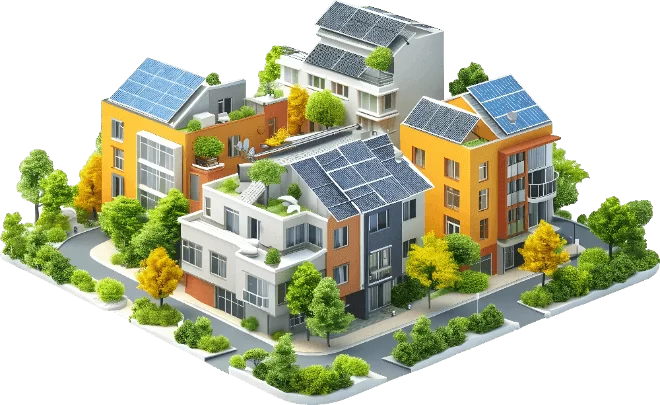
Another specific variant is electricity sharing within apartment buildings. This usually works by using a shared energy source, such as a photovoltaic power plant installed on the roof of the building, and the generated energy is subsequently distributed among individual apartments according to predefined rules. This approach allows apartment residents to efficiently use jointly generated energy and reduce electricity costs.
Another category is renewable energy communities. Unlike a standard energy community, there is a requirement that the shared energy must come from renewable sources, such as photovoltaic or wind power plants. At the same time, it is not limited only to electricity sharing — other types of energy generated from renewable sources can also be shared.
Compared to a traditional energy community, this model also has several different rules. An important difference lies, for example, in voting rights and member structure. Renewable energy communities are primarily focused on smaller local participants such as households, municipalities or small and medium-sized enterprises. The main objective is to support local, sustainable and community-driven energy systems.
In the Czech environment, renewable energy communities are currently still less widespread than traditional energy communities or the active customer model. One reason is the current legislative framework, which is more focused on energy communities and active customers. The renewable energy community model is also more specific and operates under stricter rules regarding both the type of shared energy and the structure of members.
Need help? Not sure where to start?
If you are unsure about any part of the process, need more information or would appreciate help with setup, feel free to contact us. We will be happy to explain everything and help you find a solution that makes sense for your specific situation.